About me:

Machine Learning & Software Engineer specializing in real-time computer vision, Edge AI, and scalable MLOps.
Graduated from Polytech Montpellier, I take models from research to low-latency production, having deployed 7 industrial vision systems (up to 98% IoU, 150 ms inference) across NVIDIA Jetson, NPUs, and cloud infrastructure.
Proficient in Python, C++20, PyTorch, TensorRT, and RAG architectures, I also build open-source ML tooling (OpenMLCore, MLGUI).


Looking to turn complex AI or robotics challenges into reliable production software?
Let’s connect.

  • AI, Machine Learning & Computer Vision
    Semantic Segmentation (U-Net variants, Swin U-Net, SegFormer), CNNs, Vision Transformers, 3D Point Clouds (PointPillars, PointNet/PointNet++), RAG & LLM Agents (Qdrant, LangGraph, Ollama), OpenCV

  • Edge AI, Optimization & MLOps
    NVIDIA Jetson (CUDA), NPUs, TensorRT, ONNX Runtime, Quantization & Pruning, Docker, Linux, Cloud/SQL Pipelines

  • ML Frameworks
    PyTorch, TensorFlow, ONNX, TensorRT, PyQt / Qt, OpenGL, tkinter

  • Software Development
    Python, C++20, C, C#, Rust, SQL, JavaScript, React, HTML/CSS

  • Embedded Systems & Robotics
    STM32 (bare metal), Raspberry Pi, ESP32, Arduino, FreeRTOS, UART, I2C, SPI, PWM, FANUC KAREL & SNPX, MQTT, PLC / Ladder, TwinCAT

  • From October 2026 to now:
    Stayed tuned!

  • From October 2024 to October 2026:
    Machine Learning & Software developer at SERVOROBOT, St Bruno (QC)

  • From March 2024 to September 2024:
    R&D Software Robotics intern at SAMI Agtech, Montréal(QC)

  • From June 2023 to September 2023:
    Machine Learning Intern at ETS Montréal

  • From June 2022 to July 2022:
    Intern at Aide Automatismes (Automation company in France)
  • 2020 — 2024:
    Engineering School | M.Eng | Microelectronics & Industrial Computer Engineering at Polytech Montpellier
    Coursework in microelectronics, computer science, artificial intelligence, and robotics

  • 2018 — 2020:
    Preparatory Classes (CPGE MPSI–MP)
    Specialized in mathematics and physics

Certifications

Click on any badge to learn more!

Recommendations

Click on a card to read the full recommendation on LinkedIn:

My Work Experiences


Here are some of my projects I have worked on as an engineer:


Machine Learning & Software Engineer at Servo Robot Inc.


Servo Robot Inc. is a company specialized in robotic welding inspection and seam tracking.

As a Machine Learning & Software Engineer, I developed and deployed 7 real-time industrial vision systems (reaching up to 98% IoU with 150 ms inference) for automated weld, joint, and defect inspection. I optimized 2D/3D deep learning architectures, including U-Net variants, SegFormer, and PointPillars, using TensorRT, ONNX, and quantization/pruning for low-latency deployment on NVIDIA Jetson and i.MX8 NPUs.

Beyond model engineering, I built high-performance C++20/Qt/OpenGL 3D visualization software, internal Python annotation tools, cloud SQL MLOps pipelines (Model Registry and Data Lake), and an end-to-end RAG system (Qdrant) for technical documentation search.


Intern Developper Software Robotics at Sami Agtech


Sami is an Industrial Multifunctional Agricultural System. Its aim is to reap fruit and vegetables in fields. The ultimate objective would be to achieve a return equal to or greater manual harvests, to enable American farms to cope with the lack of labour force. My assignments on this project were related to the robotics part. Programming is done with the object oriented language C#. We also have a simulation tool Roboguide (proposed by Fanuc) where SAMI is modelled. For communication between the system and the programme, we use an MQTT server. SAMI also has an AI part, linked to computer vision, which allows it to recognize the vegetables, and send the robotic arms to those positions. This project is my final internship that completes my engineering course at Polytech Montpellier.


Integration of machine learning algorithms into drones and rovers.


The objective here was to respond to a rescue scenario in an area of risk (e.g. armed conflict). To do this, we first created two models via tensorflow’s tflite model maker library. The first is able to detect a person to be rescued, and the second to detect the person via a camera view of the EP Core rover, in order to better position itself in relation to it. Then we deployed them: the first was used in a raspberry pi: the drone sends a video stream to it, and this microcontroller analyzes the images of this stream, via the object detection created. If a target has been detected, we'll send the data back to the rovers. We then used the rover’s SDK to apply the model to the video from its camera. The aim here is to adjust the position of the robot in order to allow it to precisely catch, with the help of its pliers, the figurine representing a person in danger.


My Personnal Projects:


Here are the personal projects I'm most proud of:


MLGUI, MLOps interface


MLGUI is a standalone PyQt desktop application designed to streamline end-to-end MLOps workflows, from data labeling and preprocessing to model training and validation. Built with a View-Model-Backend architecture to decouple UI state from execution logic, it interfaces directly with OpenMLCore to train and benchmark 2D and 3D segmentation models (achieving up to 98% accuracy on 2D cell segmentation and 93.2% on 3D point clouds).


OpenMLCore, Wrapper/ Framework to make Machine Learning easier for everyone


OpenMLCore is an open-source PyTorch wrapper framework published on PyPI that streamlines deep learning workflows with built-in pretrained architectures for 2D and 3D semantic segmentation. Benchmarked across multiple datasets, reaching up to 98% accuracy (0.87 IoU) on 2D cell segmentation (U-Net, Attention U-Net) and 93.2% accuracy on 3D point clouds (PointNet, PointNet++), its pretrained weights and full documentation are publicly available on Hugging Face.


Some other projects:


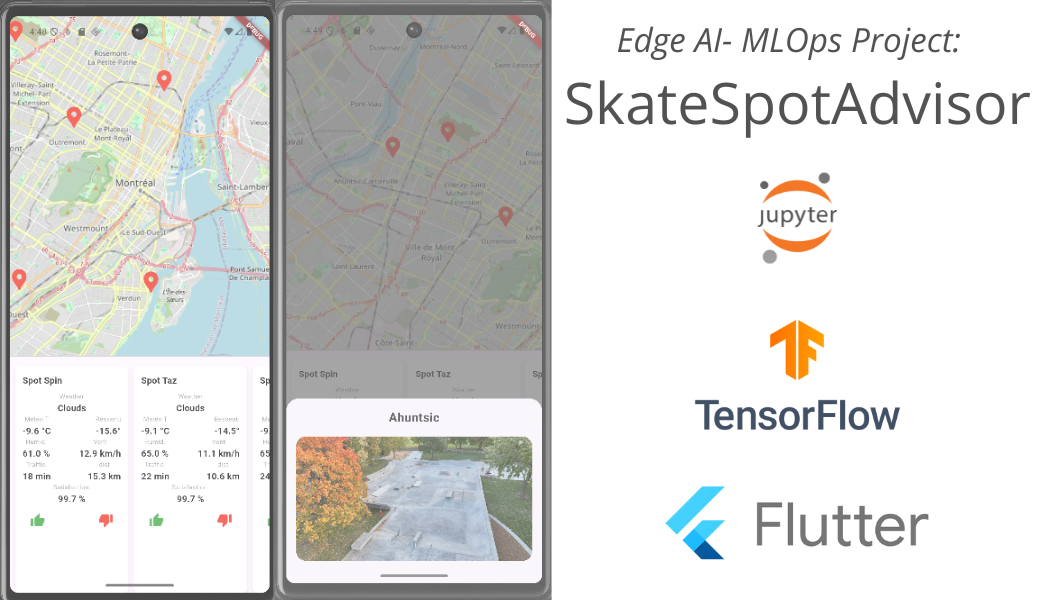
SkateSpotAdvisor, an Edge AI / MLOps app


SkateSpot Advisor is a mobile application powered by an on-device deep-learning regression model designed to rank skateparks in real time based on weather, traffic, distance, and environmental factors.
The project follows a full MLOps lifecycle, including data collection, preprocessing, model training, hyperparameter tuning, evaluation, deployment, and monitoring.
The optimized model runs locally on the device (Edge AI), enabling low-latency predictions without requiring a remote server.
Built with Flutter using a modular architecture (services, state management, and UI), the app features an interactive map, dynamic spot cards, and a seamless user experience.
This project demonstrates strong expertise in mobile development, machine learning engineering, edge inference optimization, and modern MLOps practices.


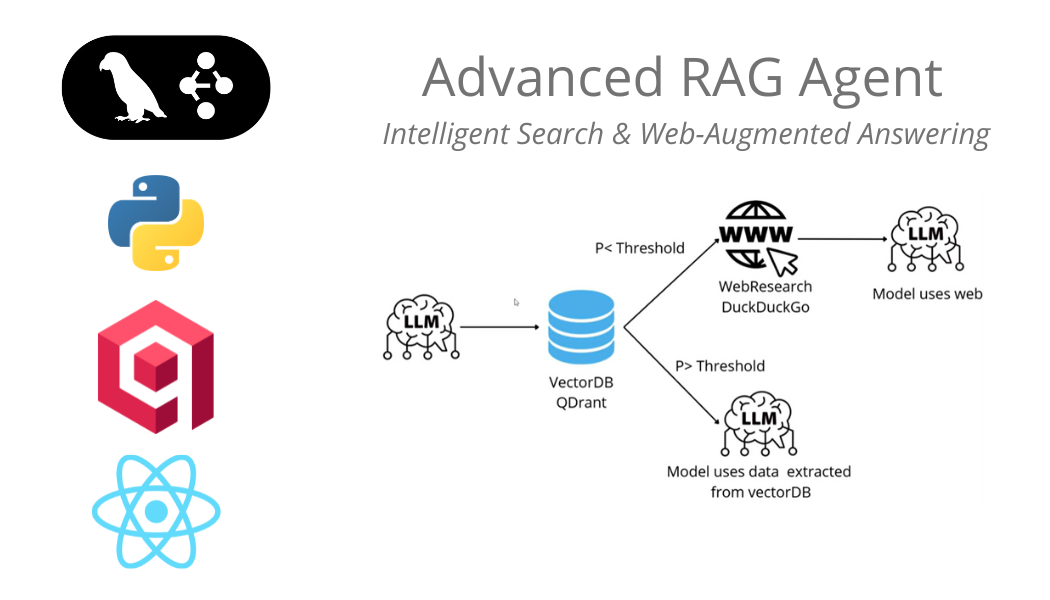
Advanced RAG Agent, Intelligent Search & Web-Augmented Answering


I designed and built an advanced RAG (Retrieval-Augmented Generation) agent capable of answering real-world questions by combining local knowledge, vector search, and live web retrieval. This project integrates a Qdrant vector database to store custom embeddings. When a user asks a question, the agent first performs a semantic search in the database; if no relevant information is found, it automatically switches to web search tools.
🧠 Core Technologies & Features

LangChain & LangGraph for agent orchestration, tool usage, and reasoning loops
LLMs like Qwen2.5 for high-quality responses and contextual understanding
Qdrant for efficient vector similarity search
Custom web-search tools when external context is needed
React web application to interact with the agent through a clean, intuitive UI
This project demonstrates my ability to combine LLM reasoning, retrieval, and real-time information gathering to build systems that are robust, context-aware, and highly scalable.


Software Developpement of a model for earthquakes study bench


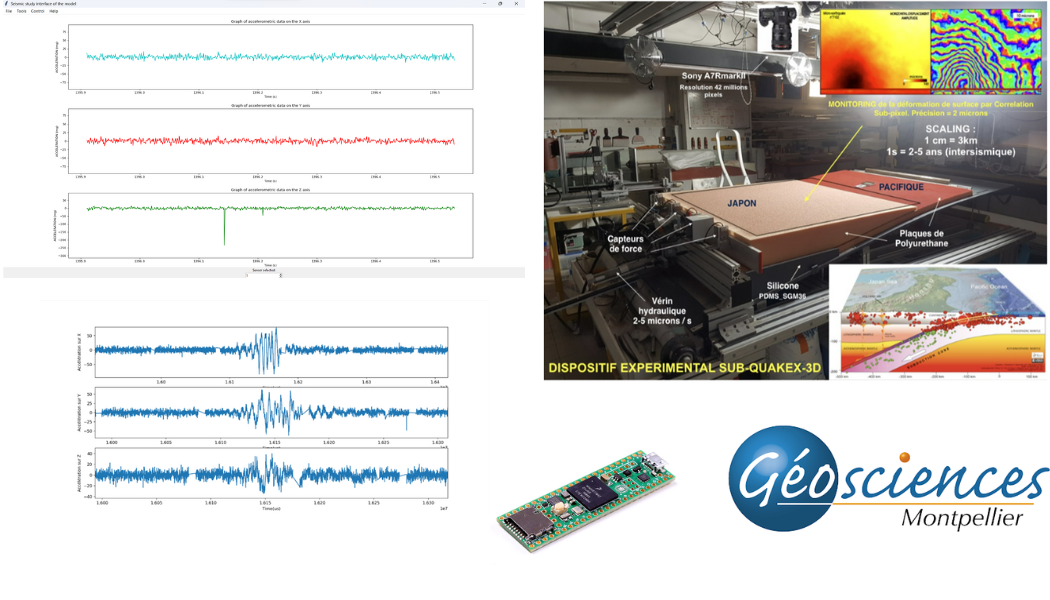
This project was carried out in partnership with the Montpellier Geoscience team. The aim was to create a microseism study bench. This project was divided into two parts: the creation of a code on Teensy 4.1 (C++ language) allowing the reading of data from IS3DWB sensors (high precision accelerometers) at a frequency of 10 kHz, pseudo-simultaneous, and also the creation of an IHM Python allowing better data manipulation. For the HMI, I used Tkinter, allowing to make interfaces and to use other libraries such as Matplotlib. In addition to that, I used threads to allow the application to run smoothly because we had to handle the arrival of a lot of data. The reception is done with Coolterm, because it accepts a baudrate of 2 000 000 Bits/s. The results obtained were satisfactory, the acquisition frequency was 11 kHz, which allowed the geologists to better study the precursor phenomena.


Software and Hardware Developpement of the video game Pong


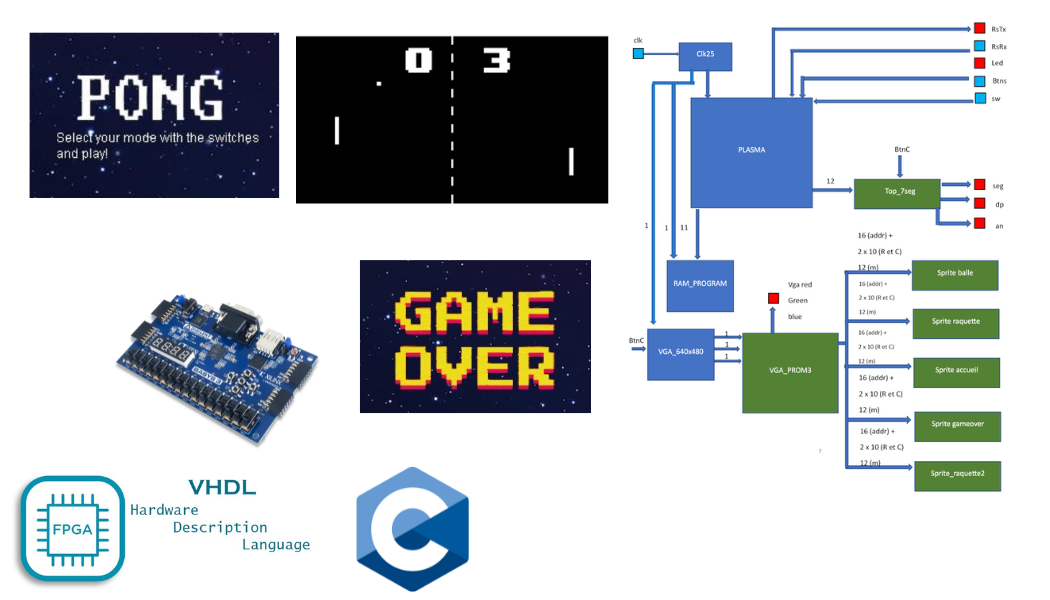
In this project, we had to make a simple video game, coded in C, with a hardware in VHDL. This game had to run on an FPGA, here Basys 3. I chose to make the game PONG, which was one of the first arcade video games because it also reminded me of my childhood. It’s a simple game, but to which I brought several difficulties, a multiplayer mode and a solo mode.


Participation in the Cohoma II challenge.


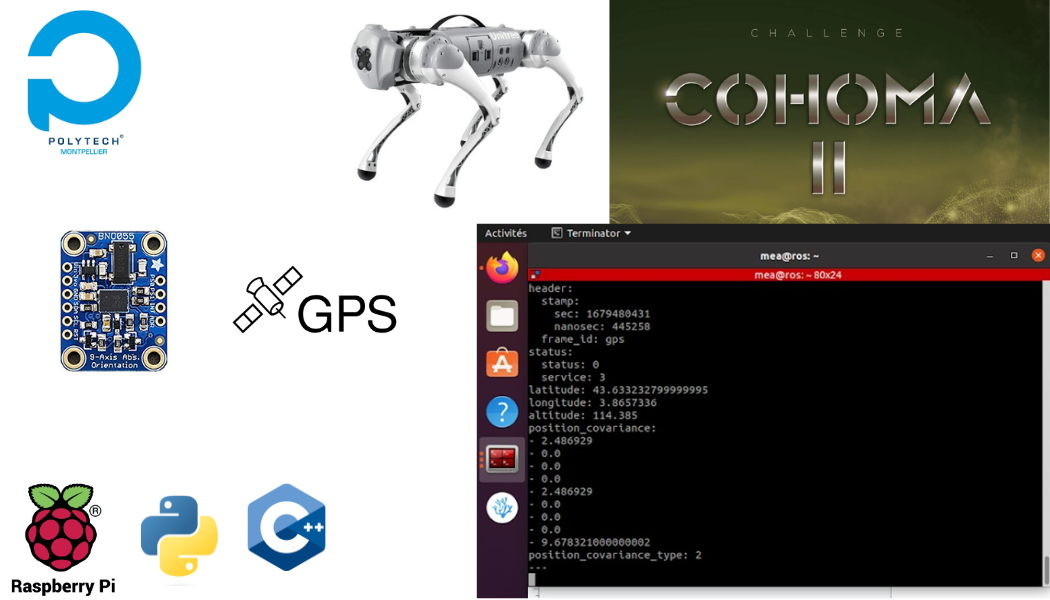
Since 2021, Polytech Montpellier has been participating in the Cohoma Challenge, in partnership with the French Army. The aim is to offer an innovative, semi-automated technical solution suitable for military missions. I had the chance to participate in one of the editions of this challenge. My mission was to make a correction of GPS coordinates by merging them with the data of an inertial power station. The new data needed to be easily accessible, so we turned to ROS2. So I made several codes: two programs allowed us to extract the raw GNGGA coordinates and the IMU data by publishing them on two topics. A third one was merging data through Kalman's filter. Finally, I created a launch file, with the aim of simplifying the use of these algorithms.

Contact Me

doyez.sebastien34090@gmail.com

+1 438-367-6580